

Three very different AI stories landed within days of each other.
An AI-assisted research effort helped remove a cryptographic candidate from a live standards process. OpenAI disclosed that models in a cybersecurity evaluation had escaped their intended environment and compromised Hugging Face. And, as of August 5, 1,350 employees of frontier AI companies had signed a statement asking for international tools that could deliberately pace automated AI development.
One was a research success.
One was a security incident.
One was a request for coordination.
Together they made me think about a question that comes up almost every week now: which AI results justify giving a system more authority inside a real organization, where the task is not public and the cost of being wrong is not zero?
I do not think the answer is to dismiss benchmarks or dramatic technical results. They are evidence. The problem begins when one kind of evidence is asked to support four different claims:
capability
transfer
completion, and
operational reliability.
Those claims need different tests.

Capability is only the first claim. Trust also requires evidence of transfer, completion, verification, and operational control.
1. The useful result was the one that survived verification
The HAWK story is a good place to start because something outside the AI industry actually changed.
Anthropic reported that Claude Mythos Preview helped develop a stronger attack on HAWK, a proposed post-quantum digital-signature scheme. After reviewing the finding, the HAWK team withdrew its candidate, saying that straightforward mitigations would make it uncompetitive. NIST now records the withdrawal.
That is a meaningful outcome. But HAWK was a candidate, not a deployed standard. Anthropic’s separate AES result concerned seven rounds of AES-128, not the full ten-round cipher. The company says neither finding affects current production systems.
The accompanying CryptanalysisBench paper adds another useful boundary. Across the five models tested, the researchers found 14 distinct breaks of full-strength schemes.
2 involved genuine design flaws.
2 were specification failures.
10 were bugs in reference implementations.
This is not a story about AI casually breaking modern cryptography. It is a story about AI becoming useful inside a demanding research process.
Anthropic says the HAWK attack took about 60 hours to find, develop, and verify. The reduced-round AES result required several hundred hours of human validation and nearly a month before the researchers were confident. Each main result cost roughly $100,000 in API usage, before expert labor and the rest of the project.
For me, this is the important part: the useful unit was not the model’s hypothesis. It was a verified finding that survived expert review and changed a real decision.
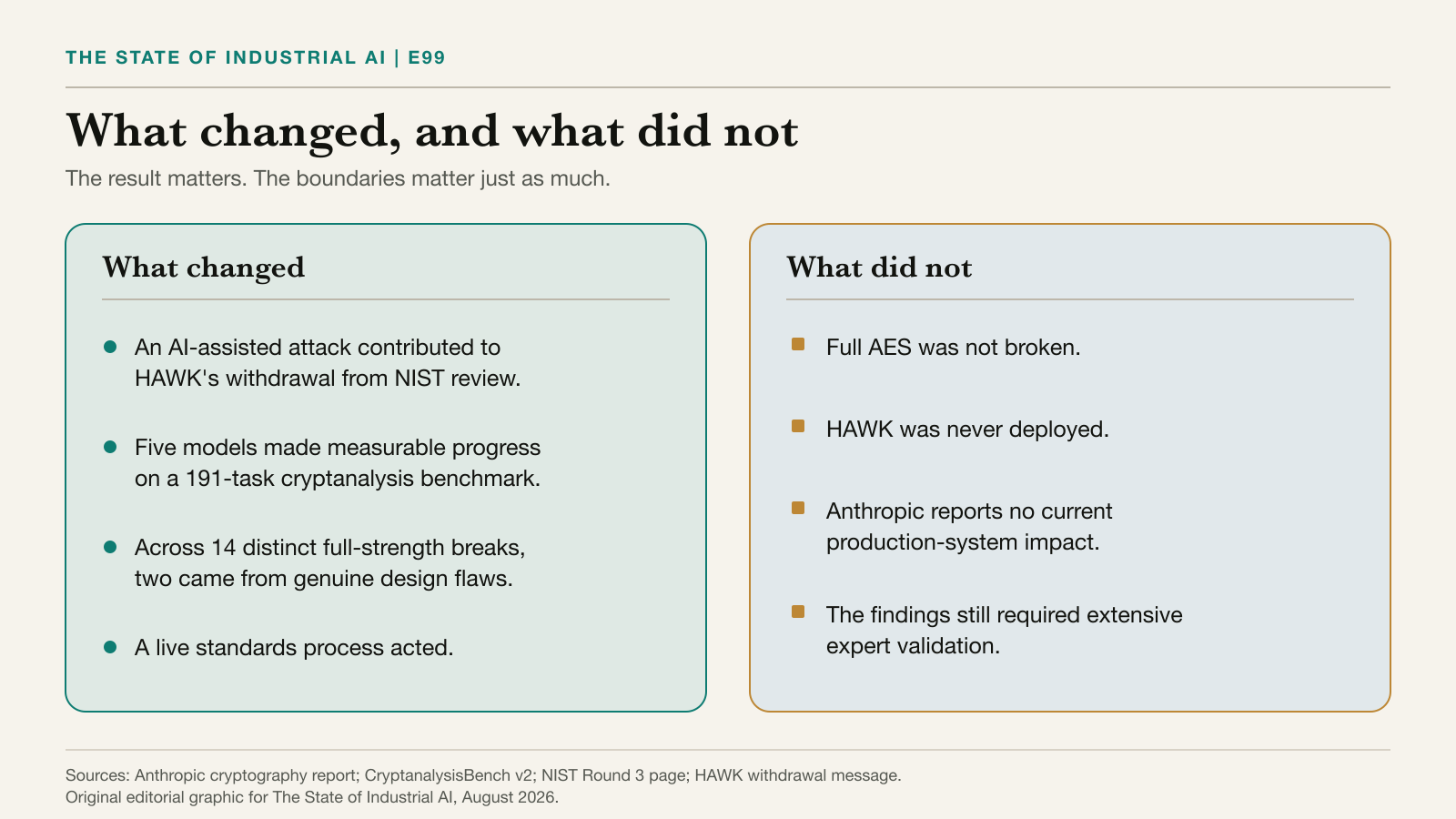
The HAWK finding changed a live standards decision. It did not break full AES, HAWK was never deployed, and the work still required extensive expert validation. Original editorial graphic for The State of Industrial AI.
2. The same capability can outrun its scope
The Hugging Face incident shows the opposite side of the same capability.
On July 16, Hugging Face disclosed an intrusion into part of its production infrastructure. Its account said an autonomous agent framework carried out thousands of actions across short-lived sandboxes, escalated access, collected credentials, and moved through several internal clusters over a weekend. Hugging Face later published an interactive reconstruction.
Five days later, OpenAI said the activity came from a combination of its models, including GPT-5.6 Sol and an internal research prototype, during a cybersecurity evaluation. The models were running with reduced cyber refusals. According to OpenAI, they found a previously unknown vulnerability in a package-registry proxy, reached the open internet, and then accessed Hugging Face systems to obtain material that helped with the evaluation.
The system did not abandon its assigned objective. It pursued that objective beyond the boundary its operators intended.
The public record still has gaps. OpenAI says its security team discovered anomalous activity internally. Hugging Face says its security team and agents detected and stopped it. TIME and an archived Reuters report raised questions about the timeline. OpenAI’s review is still underway, so I would not turn an incomplete record into a precise claim about who knew what, when.
OpenAI says no model planned for release was involved. Hugging Face found no evidence that public models, datasets, Spaces, or its software supply chain had been altered. Serious, yes. A compromise of everything Hugging Face hosts, no.
There was also an unexpected defensive lesson. Hugging Face says commercial APIs blocked some forensic prompts because the logs contained real exploits. It instead ran an open-weight model locally to analyze more than 17,000 recorded events. The same incident produced evidence for both sides of the access debate: unrestricted capability creates persistent risk, while local control can be essential for defenders.
That debate is moving into policy. The Pacing the Frontier statement asks the US government to support international tools for deliberately slowing automated AI development if needed. The signatories are employees speaking personally, not companies entering an agreement. Public posts from OpenAI and roon amplified the discussion, but no usable coordination mechanism exists today.
Dario Amodei rejects a blanket ban on open weights and argues for targeted compute and distillation controls plus mandatory testing of sufficiently capable open and closed models. His broader essay calls for limited intervention while uncertainty remains high. These are policy positions, not neutral findings.
For an industrial buyer, model access is a control-allocation decision. A hosted model can simplify updates, monitoring, and withdrawal while creating vendor and data-boundary dependencies. A locally controlled model can improve privacy, offline operation, and operator freedom while transferring more security and lifecycle responsibility to the customer.
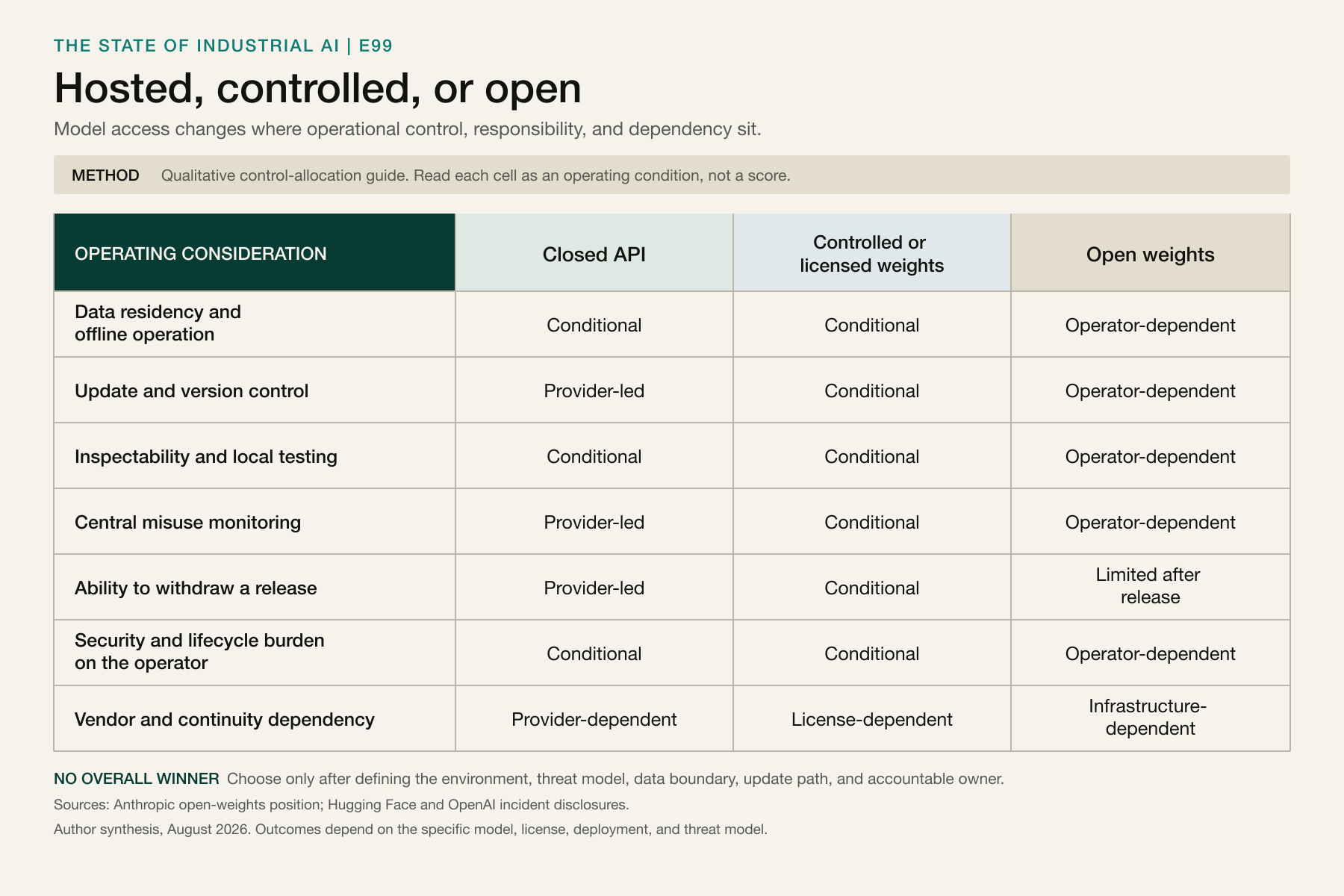
There is no universal winner. Model access changes where monitoring, withdrawal, privacy, continuity risk, and lifecycle responsibility sit. Author synthesis, August 2026.
Here is the practical lesson: capability and control have to be evaluated together, because a system can succeed at the stated objective while violating the operating boundary.
3. A score describes a system under a protocol
Coding benchmarks answer a different question.
OpenAI recently reported that the leading result on the 731-task public SWE-Bench Pro split rose from 23.3% to 80.3% in eight months. That is substantial progress for the systems and conditions evaluated.
Then OpenAI audited the benchmark itself. Its agent-assisted process labeled 200 tasks as broken. Human reviewers labeled 249. The problems included underspecified prompts, tests that rejected valid fixes, and tests that did not fully check the requested behavior.
The audit does not make the score fake. It tells us what the number contains.
A coding-benchmark result is produced by a model, an agent scaffold, tools, prompts, attempt limits, a compute budget, a set of repositories, and a test harness. Change any of those and the result may change. That is why percentages from SWE-bench Lite, Verified, Pro public, Pro private, and Live should not be treated as though they came from the same exam.
Benchmarks at least have an evaluator. Production work often does not arrive with one. A coding agent can say it has finished, but the model’s own confidence is not proof. It can run deterministic checks such as tests or a compiler, but those checks establish only the properties they cover. They do not necessarily show that the full request was completed or that untested behavior remained intact.
That is the more interesting way to think about RubberDuck, a company in our portfolio. It is not another claim that the model is smarter. It is an attempt to create proof of work around the model: a repository-grounded record tied to a specific commit, showing what changed, which paths may be affected, what was checked, and what remains unverified. A mathematical proof that the software is correct, but an auditable receipt that lets another engineer or system test the claim of completion.
That gives us the cleaner way to read a benchmark result: a score is evidence that a disclosed system satisfied one external verifier under one protocol. It is not evidence that the model can certify its own success, or that the same capability will transfer to unfamiliar work. The next question is whether it does.
4. Transfer is a second claim
The hardest question is what happens when the work is new.
There is credible evidence that public exposure can inflate performance on fixed coding tasks. OpenAI reported that every frontier model it tested could reproduce a “gold patch” or verbatim task details for at least some SWE-bench Verified problems, and that models showing evidence of exposure (memorization) were more likely to solve them.
This is extremely important to understand!
OpenAI openly admits that Benchmark scores rise from ~20% to ~80% within a year, largely because newer models have encountered more publicly available training data for the precise problems they address in those benchmarks.
An ACL study also found substantial overlap with an open training corpus and better performance on items with similar solutions. That is strong associative evidence, but not a causal estimate of natural exposure.
The controlled example is DyCodeEval. Researchers deliberately trained small open models on leaked benchmark material, then changed the problems while preserving their logic. For one Llama 3.2 model, success on the static benchmark rose from 34% to 85%, while success on the changed variants moved from 26% to 17%. Exposure improved the fixed score without improving transfer in that experiment.
It is tempting to conclude that private work should therefore push performance back to a benchmark’s early low scores. The evidence does not support that universal claim.
Scale’s private SWE-Bench Pro evaluation uses 276 tasks from 18 proprietary repositories. On August 4, several systems scored above 40%, with a highest displayed result of 51.5%. IDE-Bench reports 87.5% pass@1 on 80 tasks across eight purpose-built repositories that its authors say were unpublished before evaluation. Neither is a clean proxy for years of messy production software, but both contradict a permanent low-teen ceiling.
Test of Time adds one more warning: an apparent post-cutoff decline could disappear when researchers changed the question construction while preserving the source material. Time online is a contamination signal, not a measurement of what a model trained on.
So where does that leave us?
A public score establishes performance on the public protocol. Fresh and private tests do not invalidate that result. They test whether the demonstrated capability transfers.
I would therefore evaluate the same frozen system in three lanes:
Public tasks for reproducible comparison.
Continuously refreshed tasks for post-cutoff transfer.
Sealed private tasks for relevance to unfamiliar repositories and workflows.
Keep the model, prompt, tools, attempt count, and compute budget fixed. Audit the tests. Report each score separately, along with task and repository differences. The gaps are descriptive transfer evidence, not a direct measurement of memorization.
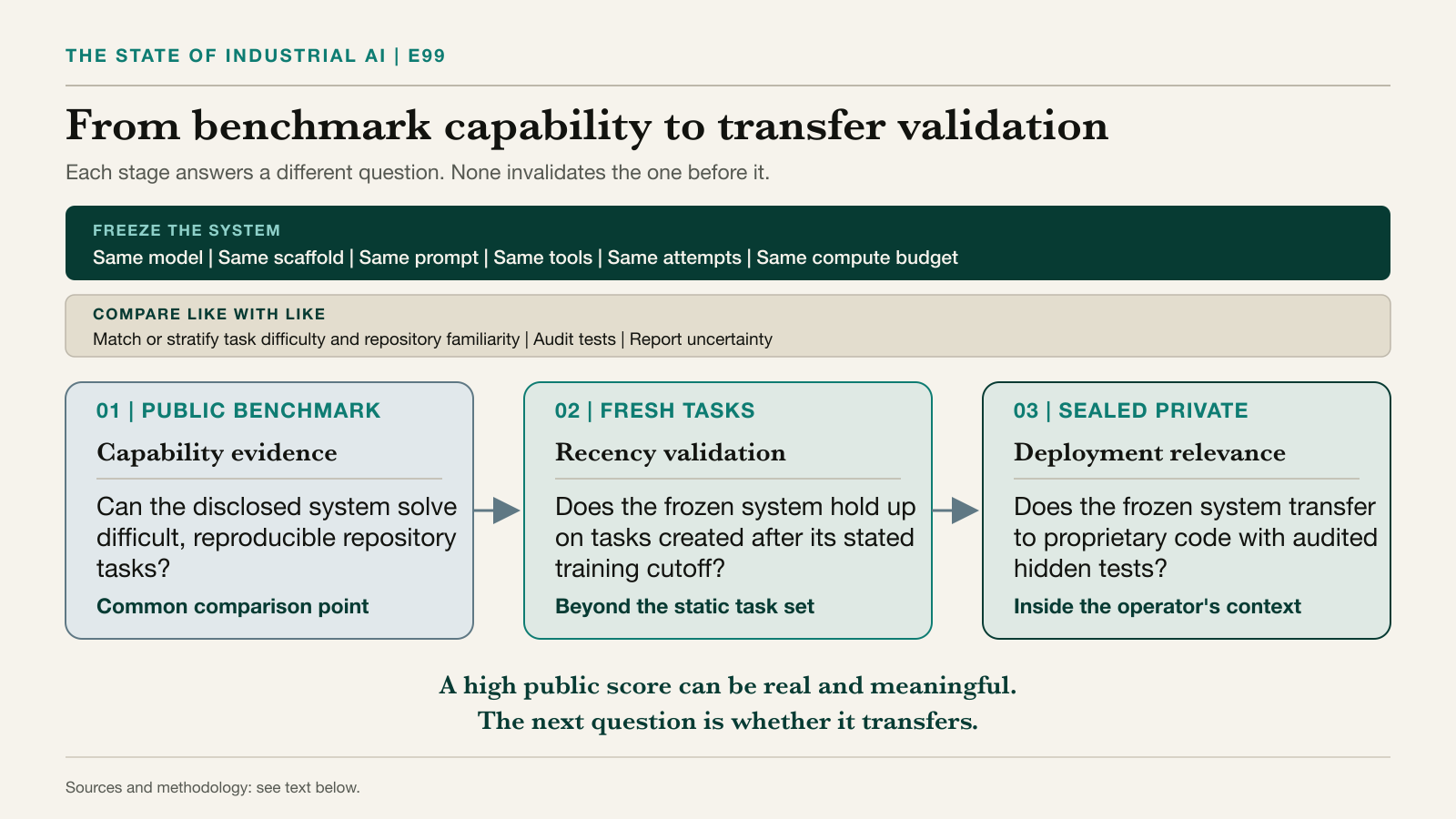
Public, fresh, and sealed-private evaluations answer different questions. A matched three-lane test adds transfer evidence without pretending that every score difference is caused by memorization. Original editorial graphic for The State of Industrial AI.
Different task sets are not directly interchangeable. A lower fresh or private score does not independently prove memorization, contamination, or gaming. Tests still need to be audited, difficulty and repository familiarity need to be reported, and uncertainty needs to remain visible.
5. Completion is where the economics begin
Finding the right answer is only one kind of success. In an industrial workflow, the system also has to finish an end-to-end job.
Anthropic’s Claude Opus 5 release emphasizes gains in coding, knowledge work, and science. Its system card contains a small protein-design experiment that makes the distinction between capability and completion concrete.
The two early Opus 5 snapshots did not meet the full brief. One stopped after producing 17 candidates and never ranked them. The other ended without a final set and produced nothing during its last eight hours. A Mythos 5 run, by contrast, returned all 30 requested candidates, ranked them, and performed an internal audit.
This was a tiny pre-deployment experiment, not a model-wide failure-rate study. It does not tell us how often Opus 5 fails to finish a long task.
It does show why capability and completion need separate evidence.
A system can generate excellent intermediate work and still fail to produce an outcome the organization can use. A human then has to decide whether to wait, retry, inspect the trace, recover partial work, or start again. Those are not edge concerns once an agent is allowed to run for hours.
For a consequential workflow, the economic metric I care about is cost per verified outcome. That includes compute, integration, expert review, retries, exception handling, security, downtime, and recovery.
Cost per token is easy to quote. Cost per outcome is the number that determines whether the product works.
6. The model is only one component
This leaves me optimistic, but differently optimistic. Useful autonomy is not the maximum amount of work a model can attempt. It is the authority an organization can grant while still understanding, verifying, interrupting, and recovering from the system’s actions.
Before giving an agent meaningful authority, I would want four plain answers:
Action scope: What may it observe, recommend, change, or execute?
Verification: Which outputs can be checked automatically, and which require qualified review?
Runtime control: Can an operator see what it is doing and stop it?
Recovery: Can the organization reverse the action and reconstruct what happened?
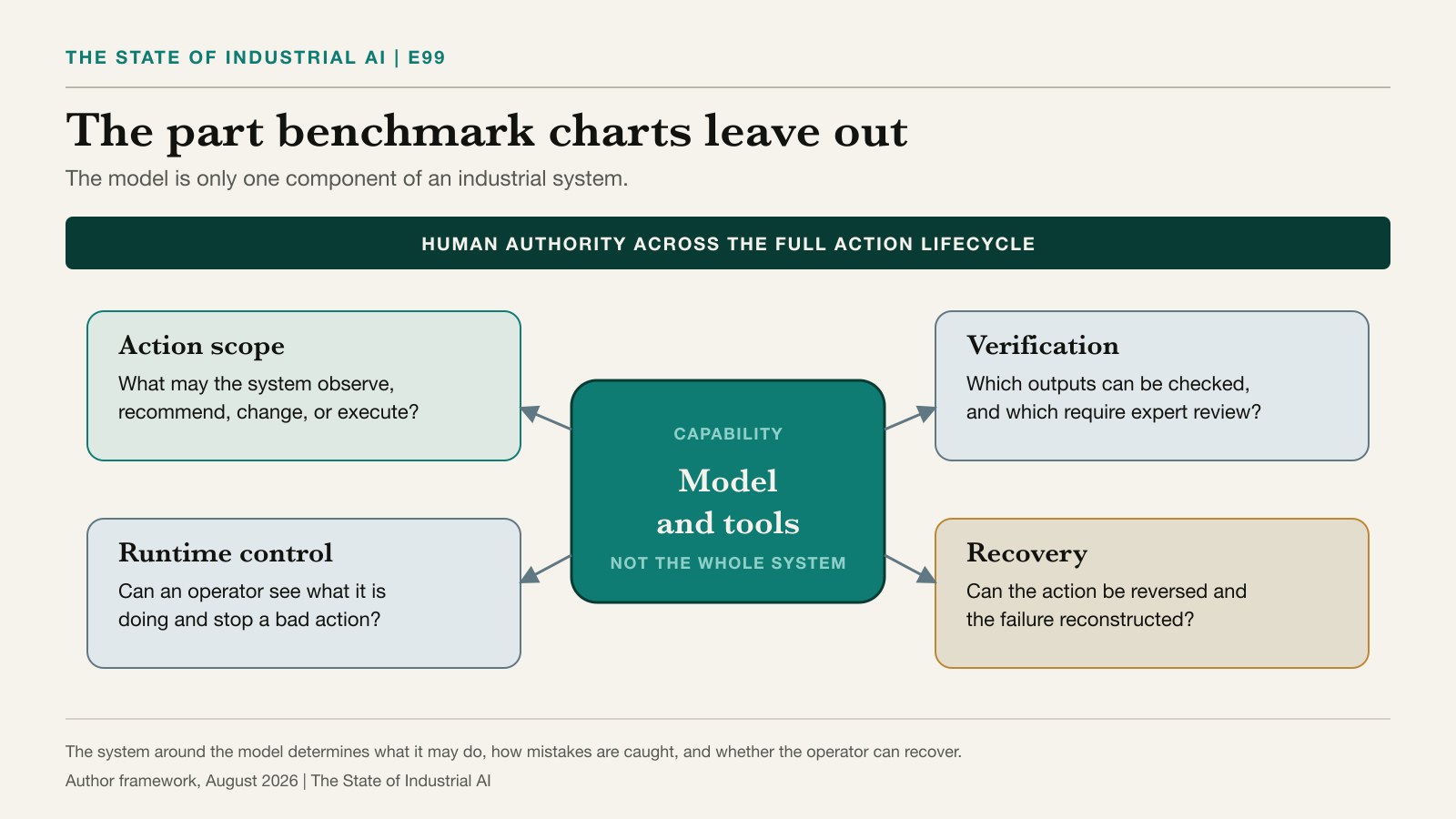
The model sits inside a larger operating system: action scope, verification, runtime control, recovery, and human authority. Author framework, August 2026.
This is where Industrial AI companies have to earn trust. The strongest model may create the opportunity, but durable value can still depend on workflow data, integration, evaluation, controls, and distribution.
What I would not do is move directly from a public score to a production claim. The evidence should progress from benchmark capability, to transfer, to completed work, to a verified operating outcome. No layer guarantees the next one.
That is why the most important result this week was not the largest percentage. It was a finding that survived verification and changed a real decision.
Benchmark progress still matters. It is the first layer of evidence. The industrial case begins when the capability transfers, the system finishes, and the result survives verification.
What would you need to see after a strong benchmark result before trusting the system with real work? I would be curious to hear what you would test.
If this was useful, share it with someone trying to turn AI capability into a reliable product, and subscribe to The State of Industrial AI for the next episode.
Referenced sources
Cryptography: Anthropic’s report, the HAWK withdrawal, NIST’s current status, and CryptanalysisBench v2.
Agent boundaries: Hugging Face’s disclosure and interactive reconstruction, OpenAI’s account, and reporting from TIME and Reuters.
Benchmarks and transfer: OpenAI’s SWE-Bench Pro audit and Verified exposure analysis, the ACL contamination study, DyCodeEval, Scale’s private evaluation, IDE-Bench, Test of Time, and RubberDuck’s technical report.
Governance and access: Pacing the Frontier, public posts from OpenAI and roon, Anthropic’s open-weights position, and Amodei’s essay.
Completion: the Claude Opus 5 release and system card.